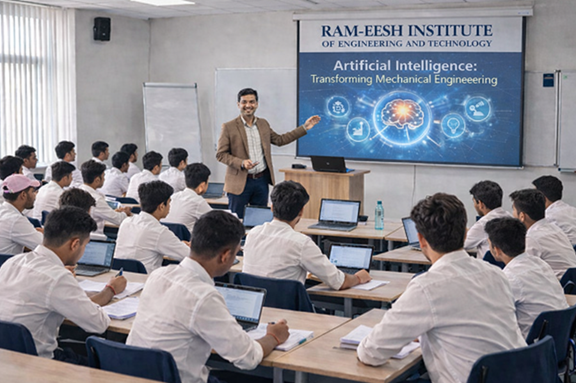
Artificial Intelligence has emerged as a transformative force in Mechanical Engineering. By combining intelligent algorithms with core engineering principles, AI enhances system accuracy, operational efficiency, and sustainable innovation. At Ram-Eesh Institute of Engineering and Technology, this transformation is experiential and industry-oriented.
The Convergence of AI and Mechanical Engineering
Mechanical Engineering has traditionally relied on mathematical modeling and experimental validation. AI introduces predictive intelligence, automation, and data-driven optimization, enabling engineers to design smarter and more efficient systems.
1. Predictive Analytics and Fault Prognostics
AI-driven predictive systems analyze operational data to detect potential failures before breakdowns occur. This shift toward predictive maintenance minimizes downtime, reduces repair costs, and strengthens reliability.
Students develop competencies in:
- Interpreting sensor and operational datasets
- Applying machine learning algorithms
- Improving system durability and life cycle performance
2. Generative Design and Optimization
AI-powered generative design enables the automatic creation of multiple design variations based on performance constraints. Engineers can select optimal models that balance strength, cost, and material efficiency.
Students are trained to:
- Utilize AI-driven design software
- Optimize components for sustainability
- Enhance production efficiency
3. Digital Twin Technology
Digital Twin technology creates virtual replicas of mechanical systems, allowing real-time monitoring and simulation. Engineers can test performance conditions digitally before actual implementation, improving safety and reducing development risks.
Societal Impact of AI in Mechanical Engineering
AI-integrated mechanical systems contribute significantly to society. Smart factories reduce resource consumption and environmental impact. Intelligent transportation systems improve safety and fuel efficiency. Healthcare technologies such as AI-assisted prosthetics elevate patient care. Infrastructure monitoring systems prevent failures, ensuring community safety and economic stability.