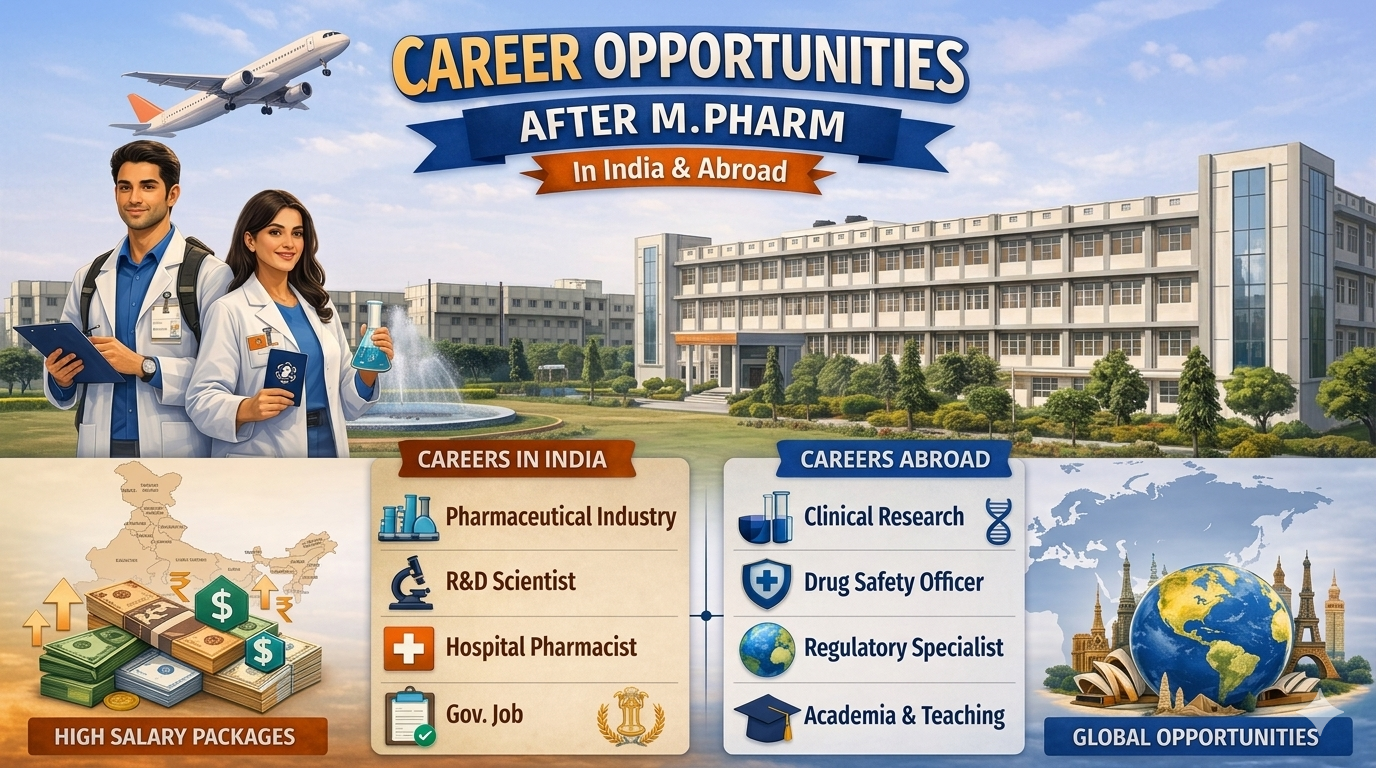
Master of Pharmacy (M.Pharm) is a postgraduate professional degree that opens diverse career opportunities in academics, pharmaceutical industries, research organizations, government sectors, and global healthcare markets. With the rapid advancement of pharmaceutical sciences, M.Pharm graduates are in high demand across multiple domains.
1.Academic Career
One of the most respected career options after M.Pharm is entering academia. Graduates can work as Lecturers or Assistant Professors in pharmacy colleges as per PCI and AICTE norms. With additional qualifications such as GPAT/NET and a Ph.D., candidates can progress to Associate Professor and Professor positions. Academia provides opportunities for teaching, research supervision, publication writing, and project handling. It is an ideal path for candidates interested in research and mentoring students.
2.Pharmaceutical Industry
The pharmaceutical industry offers wide-ranging roles depending on specialization.
In Research and Development (R&D), M.Pharm graduates can work as Formulation Scientists, Analytical Scientists, Medicinal Chemists, or CADD Scientists. They are involved in drug discovery, formulation development, analytical method validation, and preclinical studies.
In Quality Control (QC) and Quality Assurance (QA), professionals ensure that pharmaceutical products meet regulatory and safety standards. Positions include QC Officer, QA Executive, and Validation Officer.
Regulatory Affairs is another growing sector where professionals handle drug approval documentation, dossier preparation (ANDA, DMF), and compliance with national and international regulatory bodies such as CDSCO, USFDA, and EMA.
In Pharmacovigilance, graduates monitor drug safety, manage adverse drug reaction (ADR) reports, and contribute to global drug safety databases.
3.Clinical Research
M.Pharm graduates, especially in Pharmacology or Pharmacy Practice, can work in clinical research organizations as Clinical Research Associates (CRA), Clinical Trial Coordinators, or Medical Writers. They participate in clinical trials, data monitoring, and preparation of research reports.
4.Government Sector
There are several government job opportunities after M.Pharm. Graduates can appear for competitive examinations to become Drug Inspectors, Government Pharmacists, Government Analysts, or Lecturers through Public Service Commission (PSC). Research-based roles are available in organizations such as CSIR, ICMR, DRDO, and other government research laboratories. These positions offer job security, structured promotion, and attractive benefits.
5.Corporate and Marketing Roles
M.Pharm graduates may also enter pharmaceutical marketing and management sectors as Product Managers, Medical Advisors, or Senior Medical Representatives. These roles combine scientific knowledge with strategic business planning and communication skills.
6.Higher Studies and Global Opportunities
Many graduates pursue a Ph.D. in India or abroad to strengthen their research careers. Countries such as the USA, Germany, Canada, and Australia offer advanced research opportunities in pharmaceutical sciences. International exposure enhances academic and industrial career prospects.
7. Emerging & High-Demand Areas
With technological advancement, new career avenues are emerging in Artificial Intelligence in Drug Discovery, Molecular Docking, Bioinformatics, Pharmacokinetic Modeling, Nanotechnology, and Regulatory Writing. These interdisciplinary areas combine pharmaceutical sciences with computational and data-driven approaches, offering excellent future scope.
Conclusion
M.Pharm provides a strong foundation for both professional and research-oriented careers. The choice of career depends on individual interest, specialization, and long-term goals. Whether opting for academia, industry, government service, or higher research, M.Pharm graduates have promising opportunities with significant growth potential in India and abroad.
By
Prof. (Dr.) Reema Sinha
Pharmacy Department
Ram-Eesh Institute of Vocational & Technical Education ,Greater Noida.