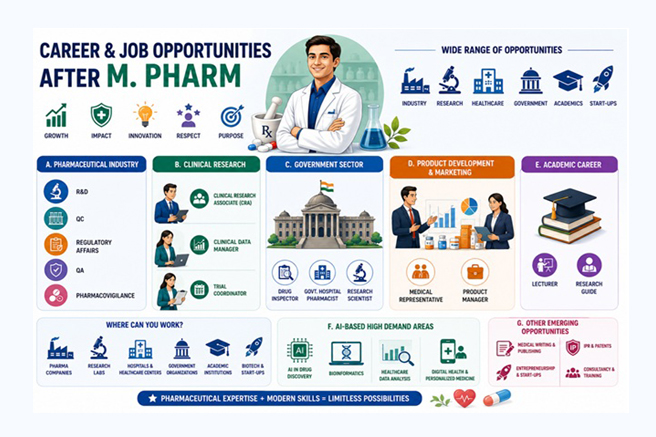
Career and Job Opportunities after M. Pharm
Numerous fulfilling and high-growth job options in the fields of healthcare, research, industry, and emerging technologies are accessible with a Master of Pharmacy (M. Pharm). M. Pharm graduates are in demand in both traditional jobs and cutting-edge multidisciplinary domains due to the pharmaceutical industry's ongoing evolution. Here is a thorough overview of the various job options available to you following the completion of your M. Pharm.
A. Pharmaceutical Industry
The pharmaceutical industry remains the most popular and diverse career destination for M.Pharm graduates. It offers multiple specialized roles:
1. R&D, or research and development
The core of drug innovation is research and development. Drug research, formulation development, clinical trials, and the enhancement of current pharmaceuticals are the tasks of experts in this discipline. Strong analytical abilities and scientific knowledge are required for this position.
2. Control of Quality (QC)
Pharmaceutical items are guaranteed to satisfy specified quality requirements by QC specialists. To ensure safety and effectiveness, they examine final goods, in-process samples, and raw materials.
3. RA, or Regulatory Affairs
Pharmaceutical product compliance with all regulatory criteria is the responsibility of RA specialists. They serve as a liaison between businesses and regulatory bodies and prepare paperwork for permissions.
4. QA, or quality assurance
Maintaining systems and procedures to guarantee constant product quality is the major goal of QA. Good Manufacturing Practices (GMP) compliance, paperwork, audits, and validation are all part of it.
5. PV, or pharmacovigilance
PV professionals monitor the safety of drugs post-marketing. To guarantee patient safety and regulatory compliance, they gather, examine, and report adverse medication reactions.
B. Clinical Research
Clinical research is a quickly expanding profession that offers positions including trial coordinator, clinical data manager, and clinical research associate (CRA). Experts in this field plan, carry out, and oversee clinical studies to assess the efficacy and safety of novel medications.
1. Clinical Research Associate (CRA): The Trial’s monitor
The integrity of a clinical trial depends on Clinical Research Associates, or CRAs. Consider them the link between the clinical trial location and the sponsor, which could be a pharmaceutical corporation.
Key Responsibilities:
• Keeping an eye on clinical study locations to make sure rules and procedures are being followed
• Confirming the accuracy and correctness of patient data
• Ensuring adherence to moral principles and patient safety
• Performing audits and site visits
In order to guarantee that trials adhere to Good Clinical Practice (GCP) recommendations, CRAs are essential. Their efforts have a direct bearing on the validity of trial findings and, eventually, the approval of a medication.
2. Clinical Data Manager: Turning Data into Insights
Massive volumes of data are produced by every clinical trial, including lab findings and patient health information. The task of gathering, organising, and protecting this data falls to clinical data managers.
Key Responsibilities:
• Creating case report forms (CRFs) and data gathering mechanisms
• Ensuring the completeness, correctness, and consistency of data
• Maintaining databases and carrying out data validation procedures
• Getting datasets ready for statistical examination
Even the best-designed trial may fail in the absence of clean and trustworthy data. Clinical data managers make guarantee that the data used to assess a medication is reliable and prepared for examination.
3. Trial Coordinator: The Operational Backbone
Trial coordinators, sometimes referred to as clinical trial coordinators or study coordinators, are responsible for maintaining order at the trial site.
Key Responsibilities:
• Organising daily trial operations.
• Finding and overseeing research subjects.
• Making appointments for follow-ups and patient visits.
• Keeping up with regulatory files and trial documents.
They are essential to a trial's human and logistical components because of their intimate interactions with sponsors, patients, and investigators. Their ability to stay organised guarantees that deadlines are fulfilled and procedures are adhered to.
C. Government Sector
Graduates of the M. Pharm program can earn prominent and secure jobs in the public sector. There are opportunities in public health departments, research organisations, and drug regulatory agencies. Drug inspectors, chemists in government hospitals, and research scientists in governmental institutions are examples of possible roles.
D. Product Development and Marketing
This domain blends scientific knowledge with business acumen. Professionals work on product lifecycle management, branding, and marketing strategies. Medical Representatives and Product Managers play a key role in promoting pharmaceutical products to healthcare professionals.
F. Academic Career
This field combines business savvy with scientific understanding. Experts focus on branding, marketing tactics, and product lifecycle management. Promoting pharmaceutical products to medical professionals is a major responsibility of medical representatives and product managers.
G. AI-Based High Demand Areas
As artificial intelligence (AI) is used into healthcare, new employment paths are opening up:
• AI in Drug Discovery: Using machine learning to find possible drug candidates more quickly.
• Bioinformatics: Biological data management and analysis.
• Healthcare Data Analysis: Analysing vast datasets to enhance treatment results.
• Digital Health & Personalised Medicine: Using AI techniques to create customised treatments.
Pharmaceutical expertise and technical abilities like programming, data analysis, and machine learning are needed in these sectors.
In conclusion, obtaining an M. Pharm provides up a variety of fulfilling career and employment options in a variety of pharmaceutical and healthcare-related fields. Graduates can pursue careers in academia, government, clinical research, production, marketing, quality control, regulatory affairs, and research and development. Strong job prospects are guaranteed in India and around the world due to the increasing demand for qualified individuals in drug discovery, healthcare innovation, and pharmaceutical regulation. Additionally, M. Pharm graduates are well-positioned to make significant contributions to society while attaining professional growth and stability due to ongoing advancements in biotechnology and medicine. All things considered, an M. Pharm degree provides a solid basis for an exciting and significant career in the pharmaceutical industry.